Implementation Scenarios
AI Governance Use Cases
The following scenarios present typical organizational challenges related to AI implementation and oversight, and SupnetAI's approach to solving them — based on ISO/IEC 42001 and the European AI Act.
Note: these are reference scenarios (problem archetypes), not descriptions of specific client implementations.
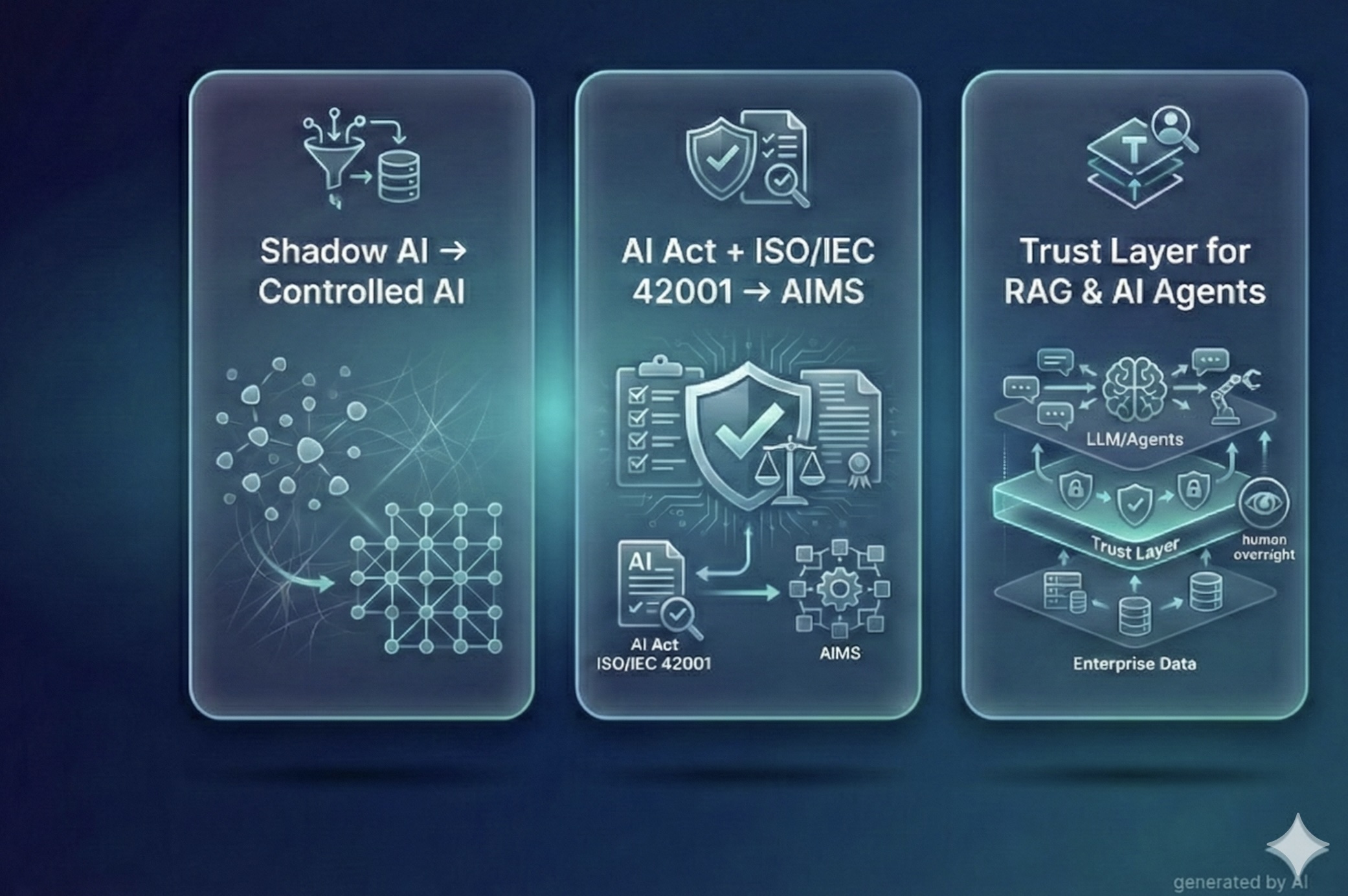
Use Case 1: Uncontrolled Shadow AI → Structured Governance
The organization discovers that AI is being used from the bottom up (SaaS, plugins, public models, automation), often without clear rules, ownership, or data control. The goal is to move from "Shadow AI" to a governance model based on roles, decision-making responsibility, and controlled AI usage paths.
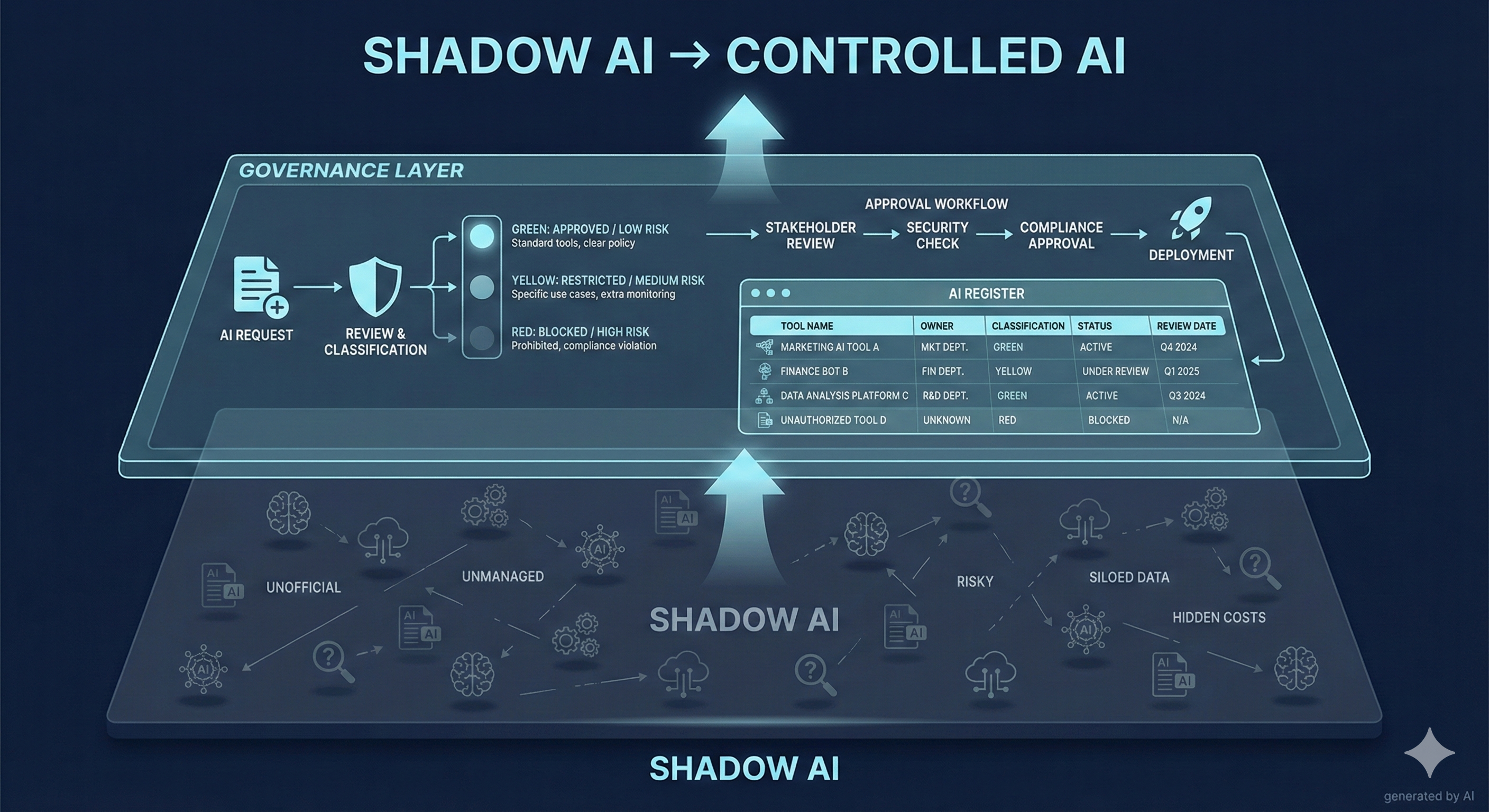 * Simplified Diagram
Typical Symptoms (In Practice)
- Technical Fragmentation: AI appears as APIs (e.g., LLM models), open-source libraries, plugins in CRM/Office, and "AI" features in SaaS – without a single register or owner.
- No Innovation Path: Teams take "shortcuts" because there is no simple process for submitting and approving a use-case.
- Blurred Decision Responsibility: "AI only suggests," but no one can pinpoint who is formally responsible for the decision supported by AI.
- Bans Don't Work: Blockades cause AI usage to shift to private accounts/devices.
Risks (Business + Regulatory)
- Data and IP: Disclosure of confidential information / PII / know-how in uncontrolled tools.
- Lack of Auditability: No decision trails or evidence of oversight (who, when, on what basis).
- Risk of Wrong Decisions: Hallucinations, bias, erroneous recommendations without a validation mechanism.
- Unprepared for Governance Requirements: AI Literacy (AI Act) and AIMS mechanisms (ISO/IEC 42001) are "on paper," not in processes.
SupnetAI Approach (Phases)
Phase 0 — Scope and Definitions Agreement
- Definition of "AI" in the organizational context (SaaS, GenAI, automation).
- Establishing critical areas (data, decisions, processes).
- Role model: who sponsors, who is responsible, who provides data.
Phase 1 — Controlled Discovery (No "Witch Hunt")
- Inventory of AI usage (scenarios, tools, data, processes).
- Identification of decision points and "risk spots".
- Preliminary classification of uses (allowed / conditional / prohibited).
Phase 2 — Governance and Decision Responsibility
- Decision Mapping: AI → decision → process → responsibility owner (RACI).
- Use-Case Risk Classification Matrix: Rules (business goal, data type, access channel, provider, integrations) → result: Low / High / Prohibited.
- "Human Oversight" Design: Approval points, escalations, risk thresholds, conditions of use.
- Minimum Evidence Pack: What must exist for a use-case to be "Approved" (evidence, owner, data scope).
Phase 3 — Operationalization and AI Literacy
- Role-based AI Literacy (IT / HR / Business) – decisions, not theory.
- BYOD Policy for AI (Bring Your Own Data/Device): Rules for using private accounts/AI tools on company devices, admissibility conditions, and "no-go" areas (PII/IP/confidential data).
- "Traffic Lights" + simple data rules (public/sensitive).
- Path implementation: how to legally submit and approve an AI use-case.
Deliverables / Artifacts
Governance Artifacts
- AI System and Usage Register (AI Register) with role classification Provider vs Deployer and admissibility status (Approved / Conditional / Prohibited).
- AI Usage Rules (policy / standard / guideline).
- Roles and Responsibilities Model (RACI).
- Human Oversight Rules + Escalation Paths.
Risk and Compliance Artifacts
- Preliminary AI Risk & Impact Assessment (for key use-cases).
- Data Rules (what is allowed, what is not, and why).
- Minimum Audit Evidence Set (evidence pack).
- Artifact Mapping to ISO/IEC 42001 (Annex A): Linking controls, roles, registers, and procedures to standard requirements – in an auditable matrix form.
- Action Plan and Implementation Roadmap (next steps).
Target Outcome
Shadow AI ceases to be "hidden," decisions have an owner, and the organization gains clear rules for AI usage and a controlled development path — without blocking innovation.
Use Case 2: Regulatory Requirements (AI Act) → Operational Readiness (AIMS)
The organization wants to approach AI systematically: on one hand, AI Act requirements, on the other, ISO/IEC 42001 (AIMS). The problem isn't a lack of goodwill — it's the lack of a plan, an owner, and a coherent decision management model.
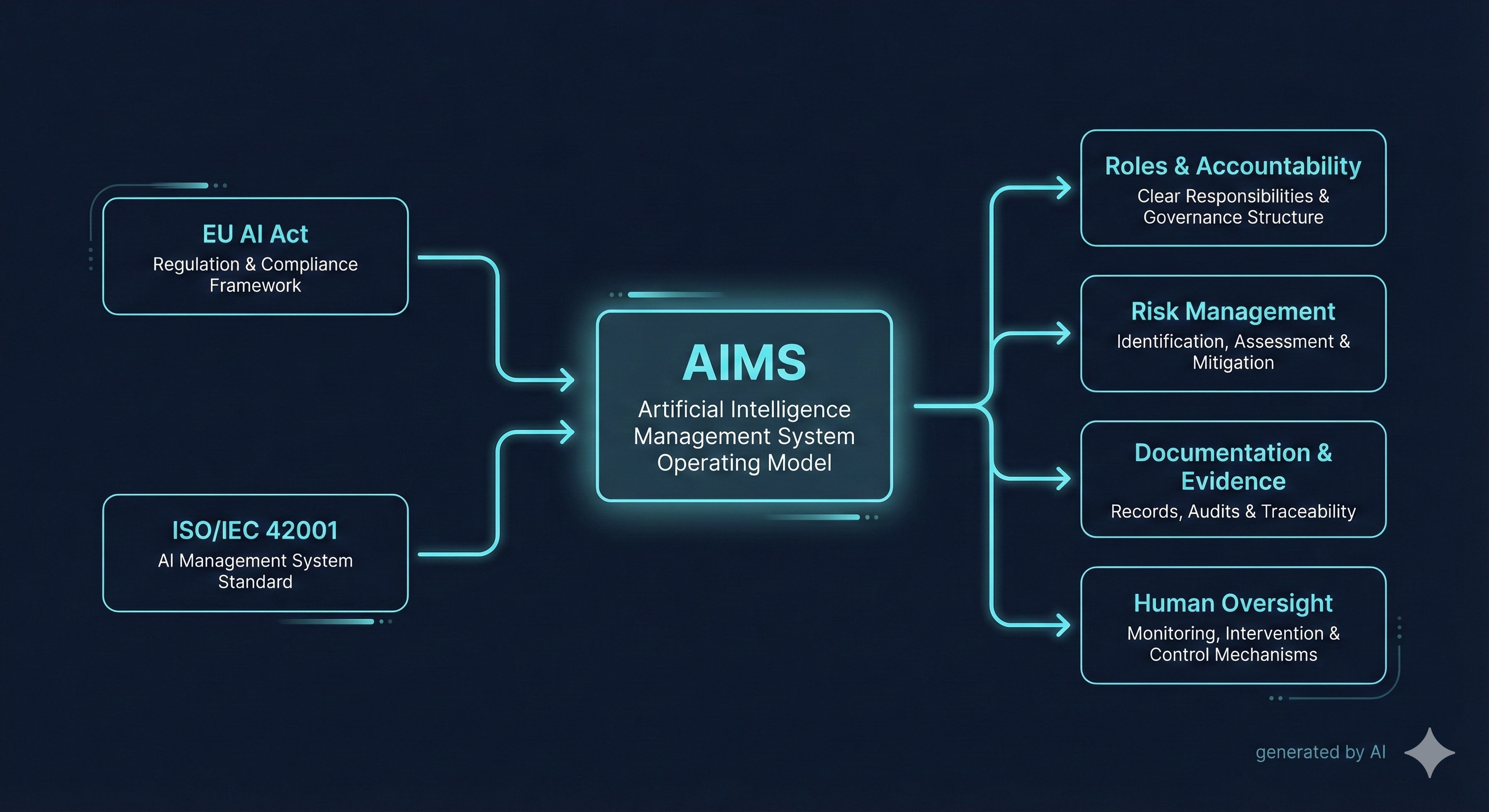 * Simplified Diagram
Typical Symptoms
- "Waiting until 2026" – no operational actions here and now.
- Compliance in documents, but not embedded in processes.
- Unclear roles: Legal vs IT vs Business.
- Decision paralysis when scaling AI.
Risks
- Apparent compliance and lack of defense "in case of an inspection".
- Lack of evidence, registers, and coherent procedures.
- Inconsistent interpretations and conflict between areas.
- Lack of audit readiness and uncontrolled scaling.
SupnetAI Approach (Phases)
Phase 0 — Readiness and Prioritization
- Readiness assessment against the AI Act (what is "now," what is "later").
- Establishing AIMS owner and governance (sponsor, owner, operations).
- Process map: where AI is in the lifecycle and where decisions are.
Phase 1 — AIMS Project (ISO/IEC 42001)
- AIMS Architecture: AI policy, roles, registers, review cycles, and decision-making rules.
- AIMS Impact/Risk Assessment: Standardized risk assessment (technical, ethical, legal) and mapping to AIMS controls.
- Integration with the ecosystem (ISO/IEC 27001, GDPR): ensuring consistency of roles, registers, and reviews to avoid duplicating procedures and treating AIMS as an extension of existing governance, not "new bureaucracy".
Phase 2 — Evidence and Audit Readiness
- Evidence Model: What we collect, who is responsible, where we store it, how often we review.
- Decision Trail (Audit Trail): Recording approvals, changes, reviews, incidents, and corrective actions.
- Human Oversight in Practice: Evidence of human supervision (control points, roles, acceptance criteria, tests).
Phase 3 — Legal Alignment (When Required)
- Interpretive consistency between the AI Act and documentation.
- Law firm support in areas requiring legal expertise.
- Proportionality: minimum necessary + reasonable scalability.
Deliverables / Artifacts
AIMS Artifacts (ISO/IEC 42001)
- AI Policy and Governance Rules (framework and responsibilities).
- Registers: AI Register, risks, incidents, corrective actions.
- Procedures: approval, change, withdrawal of AI systems.
- Review Model: KPI / KRI, risks, oversight, improvement.
AI Act Artifacts (Operational)
- Map of obligations and roles (provider/deployer) + actions.
- Evidence Pack: what to collect, where, who is responsible.
- AI Literacy – competence plan (role-based).
- AI System Documentation Package (where applicable, e.g., for High-Risk): Structure of technical and evidentiary documentation compliant with AI Act requirements (including elements from Art. 11 and Annex IV, if applicable).
- Implementation Plan and Compliance Roadmap.
Target Outcome
The organization has a coherent AIMS (ISO/IEC 42001), and AI Act requirements are "embedded" in processes and evidence. Interpretive chaos disappears, and AI can be scaled in a controlled and auditable manner.
Use Case 3: GenAI Hallucination Risk → Secure Trust Layer
The organization is implementing GenAI solutions (RAG, AI agents) to work on internal data: documents, procedures, expert knowledge. The challenge is to ensure that responses generated by AI are reliable, secure, and accountable — both business-wise and strictly regarding regulations.
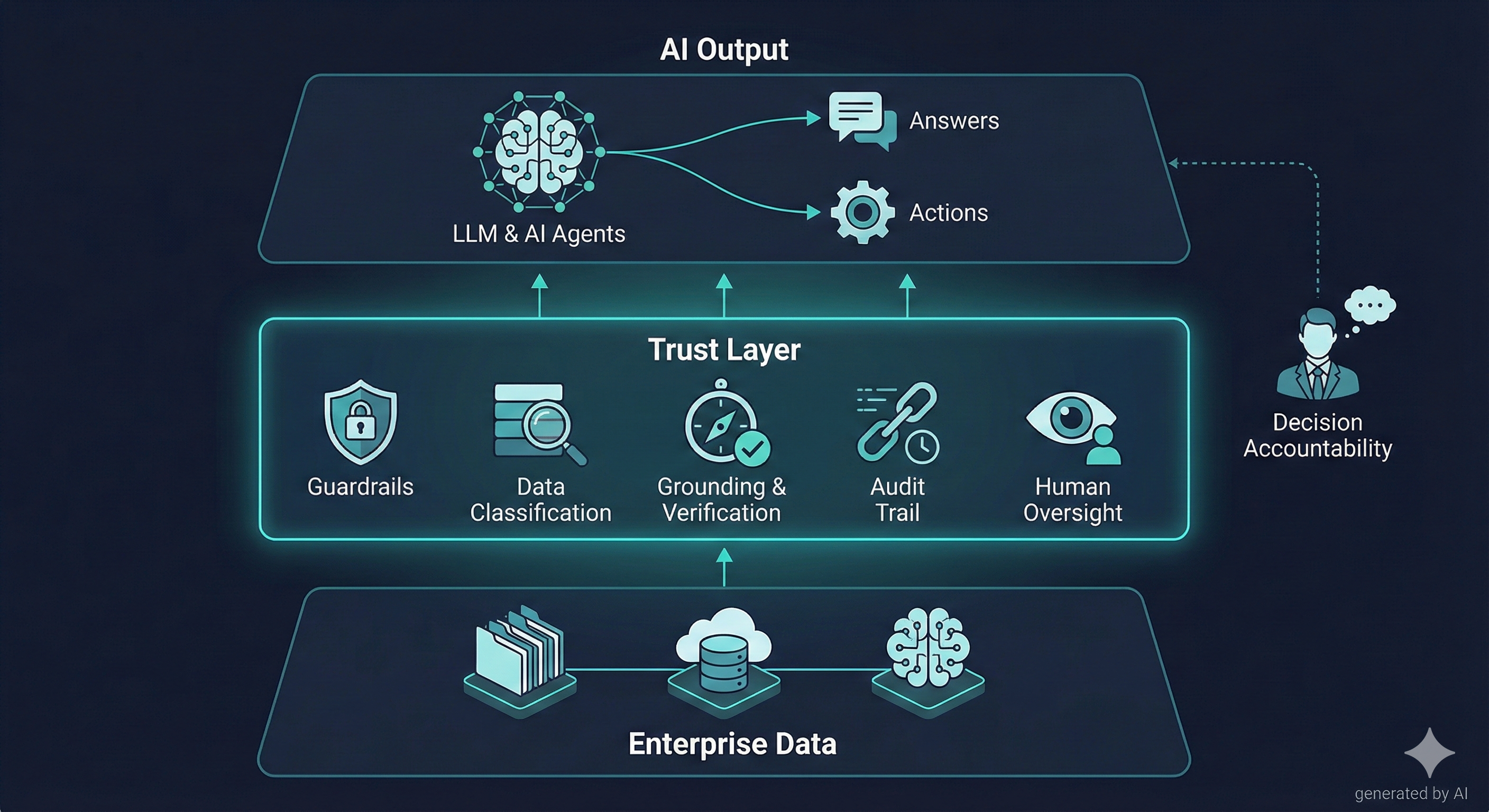 * Simplified Diagram
Architectural Context
- LLM models connected to internal knowledge repositories (RAG).
- AI agents performing action sequences (e.g., document analysis, recommendations).
- Data of varying sensitivity: public, internal, confidential, regulated.
- Lack of a consistent "owner" responsible for the response generated by AI.
Key Risks
- Hallucinations: Responses sounding plausible but unsupported by sources.
- Prompt Injection: Manipulation of queries leading to data disclosure.
- Lack of Accountability: Inability to indicate why AI gave a specific answer.
- Regulatory Risk: No decision trails or evidence of oversight (AI Act, ISO 42001).
SupnetAI Approach (Trust Layer)
1. Defining Trust Boundaries
- Classification of data available for RAG (what AI "can see").
- Determining which AI decisions are informational and which require approval.
- Assigning an owner of responsibility to classes of AI responses.
2. Guardrails and Usage Rules
- Data Policies: Restrictions on context, scope, and tone of response.
- Query Security Rules (prompt hygiene, injection protection).
- Conditions under which AI must refuse to answer or escalate to a human.
- Effective Human Oversight (AI Act – Art. 14, where applicable): Designing interfaces and control points enabling real human intervention (escalation, stopping, overriding a decision), not just "facade approval".
3. Grounding and Verification
- Requirement to base answers on specific sources (retrieval-based answers).
- Mechanisms signaling insufficient data.
- Separating "knowledge" from "interpretation" in AI responses.
4. Audit Trail and Oversight Evidence
- Recording queries, context, sources, and AI responses.
- Decision Trail: who approved, who used, in what process.
- Human Oversight evidence compliant with AIMS (ISO/IEC 42001).
Deliverables / Artifacts
Governance Artifacts
- Responsibility model for AI-generated responses.
- RAG and AI Agents Usage Policies.
- Escalation and response approval rules.
Evidentiary Artifacts
- Query and response register (audit trail).
- Evidence of human oversight and response quality tests.
- Mapping mechanisms to ISO/IEC 42001 (Annex A).
Target Outcome
The organization can safely use RAG and AI agents in business processes, maintaining control over data, response quality, and decision-making responsibility — without blocking innovation and without the risk of a "black box".